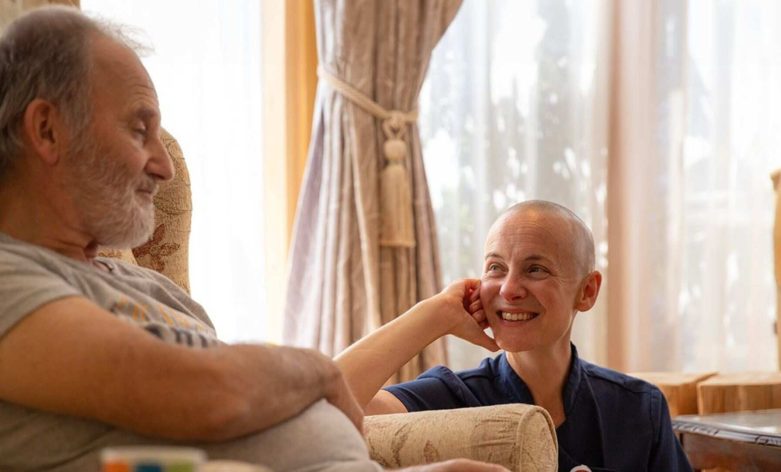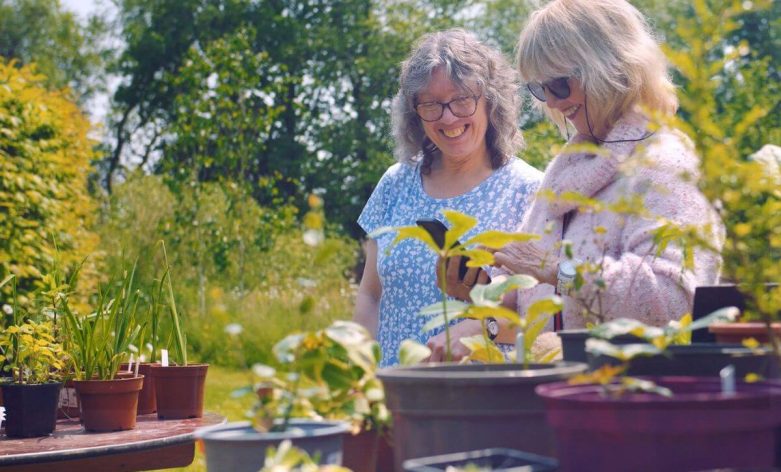

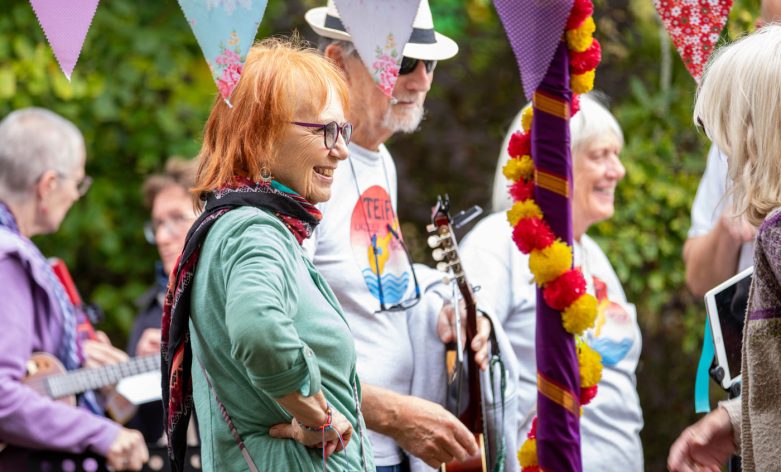
The hospice sector’s call for reform in the face of a funding crisis is clear and urgent, and we support it wholeheartedly. But while systems are being redesigned, people still need care today.
We believe there is a model that works — not as a replacement for proper funding, but as proof that a volunteer-led approach can not only sustain care, it can expand it.
What is the problem with hospice funding?
Across Wales, the hospice funding model is under severe strain. Nearly 30% of Welsh hospices are already reducing beds or services. Over 70% of those with inpatient units expect beds to close.
Marie Curie’s Better End of Life Report found that one in three people were severely affected by pain in their final week of life, and one in two visited A&E in their last three months.
Expanding care when others are forced to contract
From March 2026, Skanda Vale Hospice is increasing its inpatient respite service from four nights to six. For patients, it means longer periods of rest and skilled support. For families, it means more breathing space. And for us, it forms the foundation for our longer-term ambition to provide 24/7 end-of-life care.
In 2025, our respite service supported 42 patients and 28 family members — and every one of those stays was provided free of charge, regardless of people’s location, background or beliefs. Inpatient respite, day hospice and remote companionship are funded entirely by charitable donations, with no statutory funding at all.
So how is this possible, at a time when so many others are being forced to contract?
A volunteer-led model for hospice care
Skanda Vale Hospice is believed to be the only hospice in the UK with a predominantly volunteer-led clinical care team.
Eleven registered nurses, twenty-four healthcare assistants, nine patient assessors and two doctors give their time freely, supported by a small core of paid nurses who ensure continuity and compliance. Every volunteer works to the same clinical standards and governance frameworks as any NHS or private healthcare setting. This is skilled, regulated, person-centred palliative care — delivered by people who have chosen to be here.
The senior leadership team — Head of Care, Head of Operations, Head of Communications, Head of People, Head of Finance and Hospice Manager — are unpaid too. So are the 132 other volunteers who prepare meals for patients and families, maintain the building and grounds, offer companionship, and run the charity shop in Newcastle Emlyn.
The most recent independent inspection of the hospice, by Healthcare Inspectorate Wales in April 2026, found no immediate concerns and described the care here as “kind, dignified and person-centred.” All 55 team members surveyed said they would be happy for their own family to receive the care we offer. The model isn’t only working. The regulator says so too.
On our busiest days, around forty people sit down for lunch together — patients, relatives, nurses, carers, administrators, cooks, gardeners. The quality of care a patient experiences is shaped as much by the person who lays the table as by the nurse who takes their observations.
In this video, Sue Harding, our Housekeeping Lead, explains how cleaning goes beyond work and is about creating something beautiful for people at an important time in their lives:
What volunteers bring to hospices
Volunteering isn’t a cost-cutting strategy here but an organising principle. Here are four benefits that a volunteer-led model can bring to hospices.
1. Increased capacity
It increases capacity without lowering standards — and it creates a culture where people have the time to give the steady attention that good palliative care requires.
Something shifts when care is not driven by the clock. During respite weeks, staffing is at least one-to-one, and at times two-to-one (or higher) — which means there’s time to sit with someone, notice small changes, and talk without rushing.
Here’s our volunteer Cate’s story of finding the joy in nursing again:
We welcome clinical volunteers from across the UK with free accommodation, meals and travel expenses provided during your stay.
2. Experience
But time alone doesn’t explain it. Many of our volunteers bring something that can’t be taught from a textbook: decades of life experience, of caring for their own families, of sitting with people through difficult moments outside any professional setting.
3. Attunement to patients
Jane Davis, our Lead Carer and a retired district nurse, describes it as having antennae — “you go in to do one job, but as you walk through the door, you think: she’s not herself. She’s not talking the same, she’s not walking the same.” That instinct, honed over a lifetime, is what shapes the care here.
4. High standards of care
The result is care that pays attention to everything. A patient who arrives, in Jane’s words, “looking pale and frightened” and leaves with rosy cheeks, saying they’ve had a good day.
And this is the thing worth understanding: the model works precisely because the standard of care is high. People give their time to something that meets the standard they hold for themselves. The volunteering sustains the care, and the care sustains the volunteering. Each makes the other possible.
“Amongst other things, Skanda Vale Hospice has given me time to think, to organise my thoughts, and experience companionship in a way I never thought existed.”
— Family Member
A guesthouse that funds hospice care
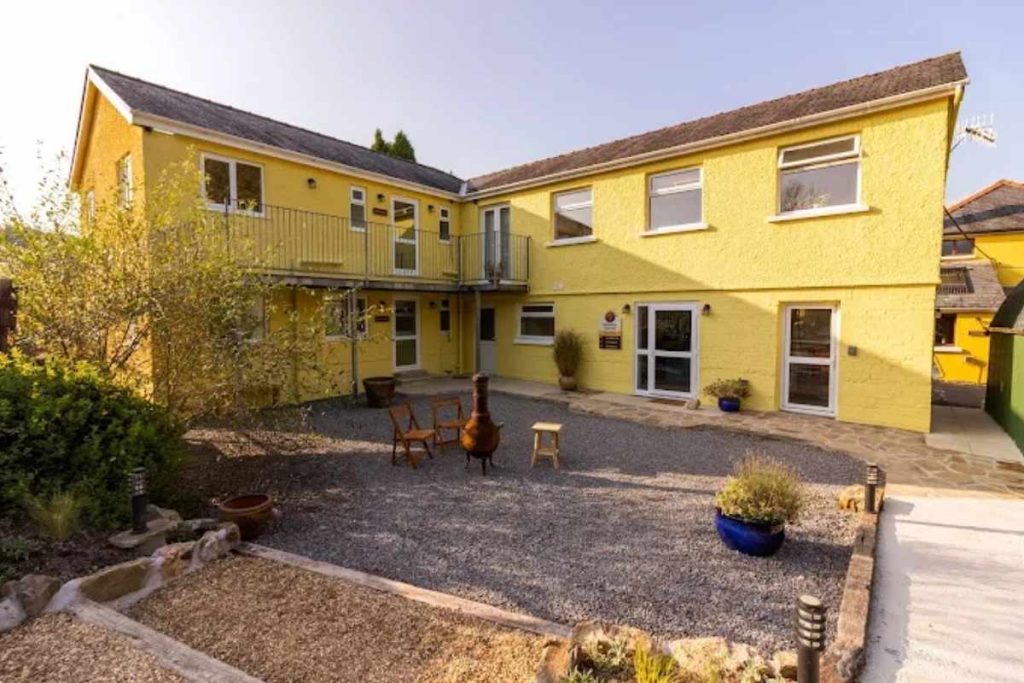
One of the most practical elements of our model — and perhaps the most transferable — is Skanda Hafan, a guesthouse owned and run by the hospice.
Skanda Hafan offers modern, self-contained accommodation fifteen minutes from the hospice: individual rooms, a bunkhouse and a farmhouse. It is open to the public as a holiday let, and all profits go directly to the hospice. But it also serves a second, equally important purpose: providing free accommodation for healthcare professionals who volunteer with us.
The property was purchased with the help of a £260,000 grant from the Brechfa Forest West Wind Farm Community Fund. It is run by volunteers. This means the guesthouse generates a reliable, independent income stream — reducing our reliance on donations.
Providing free accommodation enables volunteering
Skanda Hafan also removes the single biggest practical barrier to sustained clinical volunteering: the cost of somewhere to stay.
Healthcare professionals come from across the UK. Some stay for a week at a time, fitting volunteering around other commitments. Others come for longer. All receive free accommodation, meals, travel expenses and freshly laundered uniforms.
This dual-purpose approach — a property that earns income for the charity while housing the volunteers who deliver its care — could work for any hospice or care organisation with access to capital, grant funding or community investment. It is a tangible, replicable step toward building a volunteer infrastructure that is designed to endure.
“You come into work without thinking you’re coming to work. It’s made my life purposeful. It’s filled a big, big void.”
— Ahalia Seelan, Volunteer Head of Quality and Clinical Governance.
Transferable solutions for hospices in a funding crisis
Our hospice was founded by Skanda Vale, a monastic community with a long tradition of service — and that heritage matters. But the hospice itself was built from scratch: monks, nuns and supporters began with a home care service, offering hands-on care and companionship in patients’ own homes.
Today, the vast majority of our team are local volunteers with little or no connection to the monastery. What began in a particular spiritual context has become something broader — a way for a community to care for its own.
We’ve spent thirty years learning what works, and much of it has nothing to do with our particular origins.
Treat volunteers as professionals
The principle of treating volunteers as a professional team — with proper induction, clinical supervision, clear boundaries and genuine accountability — is available to any organisation willing to invest in it. And when volunteers have real roles with real responsibility, when they feel genuinely part of the organisation rather than an add-on, they commit.
Remove barriers to volunteering
The same is true of practical barriers: remove the small things that get in the way (travel costs, meals, somewhere to sleep, a clean uniform), and people will show up consistently.
Invest in accommodation
And the dual-purpose property model — an asset that generates income while solving a staffing problem — could be adapted by any hospice with access to capital or community investment, even if the specifics look different.
How a volunteer-led model can expand hospice care
None of this removes the need for systemic funding reform. The sector needs sustainable government funding and a commissioning framework that recognises hospice care as essential — not optional. But it does suggest something hopeful: with the right structure, care can expand without becoming thin.
The evidence is here — in a small hospice in rural West Wales that is expanding its services at a time when expansion feels like the last thing anyone expects.
The hospice has held to its founding principle for more than thirty years. What we have found is that people are sustained by the work itself. There is a deep, abundant energy in purposeful work — especially when that work is focused on the care and uplift of another — and it is why this model holds.
An open invitation to hospices
We’re still learning, and we’d be as happy to talk about what didn’t work as about what did. If you lead a hospice, a care service or a palliative team and any of this prompted a question — we’d genuinely welcome the conversation.
We’re happy to share governance frameworks, induction materials, role structures and the practicalities of running Skanda Hafan, not as a template, but as a starting point for someone else’s thinking.
And if you are a nurse or healthcare assistant, and something in this story resonated, we would love to hear from you. We offer free accommodation, a calm and well-organised working environment, and the chance to practise in a way that many people tell us they have been looking for. There is no pressure and no expectation beyond a genuine desire to care.