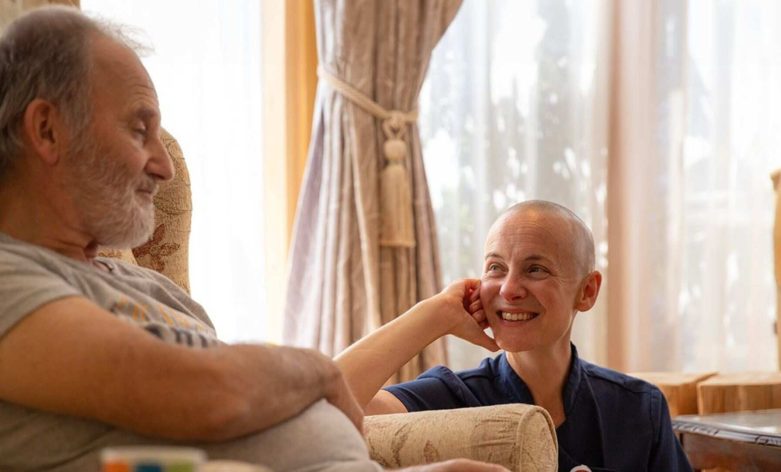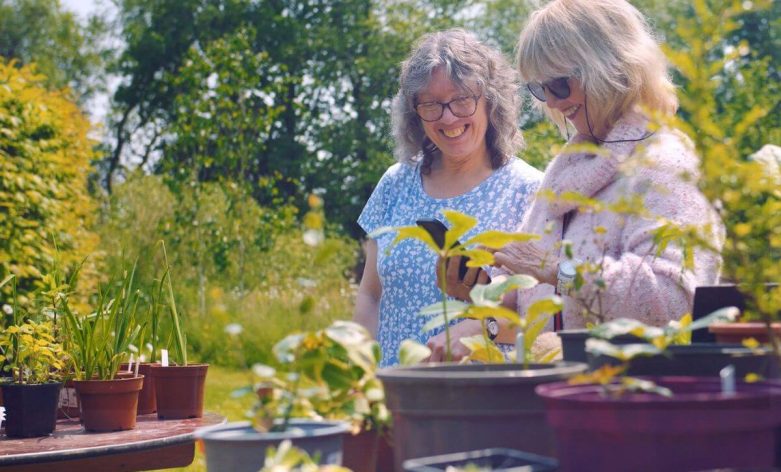

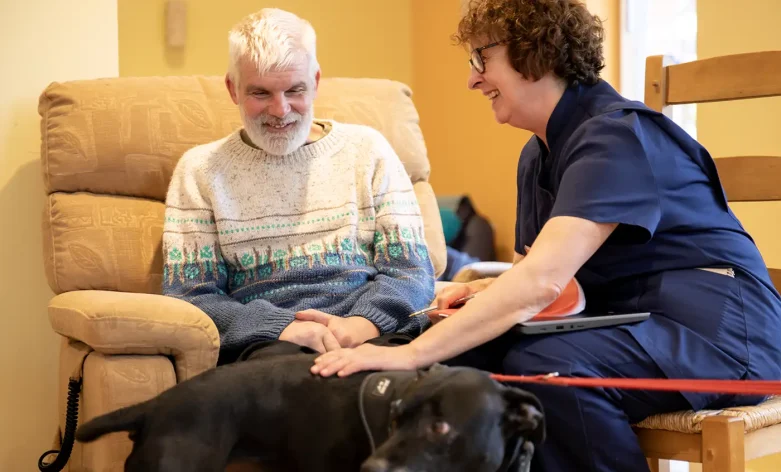
Three retired nurses. Three different routes into volunteering at a hospice in West Wales. One thing in common: they still get to do the bit they always loved.
Jane Davies was a district nurse. She retired, decided she didn’t want to re-register with the NMC, and also decided she didn’t want to stop caring for people. So she joined Skanda Vale Hospice as a volunteer, and over time became our Lead Carer — a senior role on the care team that doesn’t require a nursing pin, but absolutely requires a nurse’s instincts.
“It’s like being a district nurse,” she says. “You go in to do one job, and as you walk through the door, you think — oh, she’s not herself. She’s not talking the same. She’s not walking the same. Her dinner’s untouched. All those things twiddle in your brain as you walk through the door. I use the same antennae here.”
She is also, in her own words, a magistrate, a fire warden, learning Welsh, married, a dog-owner, and seldom at home. “I’m retired,” she says, “and I seem to be out every day.”
This post is for retired nurses anywhere in the UK. If you’re wondering what to do with the skills and instincts you haven’t quite managed to put down, we can help. We’ll walk through four routes into volunteering with us, the practical things you’ll want to know, and — because we know most of you won’t live round the corner from a small Welsh hospice — the free accommodation we offer to volunteer clinicians who travel in for our respite weeks.
But first, the two women who took different routes to the same place.
Cathy — still registered, still working, still loving it
Cathy Williams had the kind of career most nurses dream about. Paediatric intensive care in the UK, then in New Zealand, where she was on the flight retrieval team bringing children in from Fiji and Samoa by helicopter and light aircraft. Back in the UK she worked as a senior nurse, a practice educator at a children’s hospice in Surrey, and an infection prevention lead for her local health board.
When she took semi-retirement she moved to Llanpumsaint and went looking online for a hospice to volunteer at. She found us. On her first visit she recognised something she hadn’t been expecting.
“There was a sense of peacefulness,” she says. “It was smaller, homely, comfortable. Everybody’s smiling. It felt like home.”
She began coming in one day a week as a volunteer reflexology and massage therapist and soon felt part of the team. When a part-time paid nursing role came up for our respite weeks, she said yes. She now does forty paid nursing hours a month, volunteers alongside as a therapist, and leads our infection prevention programme.
On the job satisfaction question, she doesn’t hesitate. “I have much more job satisfaction,” she says, “because I’m doing what I want to do. I’m able to put the patient first and foremost.”
Her story is in the video below.
Cathy on coming back to hands-on nursing, and what the hospice gave her that she hadn’t known she was looking for.
Return to practice at 58: how Cate came back to nursing
Cate Langley had already retired once when she came to us. Thirty years a midwife, the last few at consultant level, and by fifty-five and a half, she was done. She joined us as a healthcare support worker. Baths, walks in the garden, unhurried conversations, time…
She did that for a while, and loved every day of it. But she could see what the registered nurses around her were doing — the symptom management, the medication, the quiet clinical conversations at the bedside — and she started wanting more of that again herself. Her nurse registration had lapsed during her midwifery years; the dual-registration rules had shifted partway through her career. Getting it back would mean a Return to Practice course. The nearest ones were in Swansea or Cardiff. Hours from home. Realistically, no.
One weekday afternoon she was standing in the hospice kitchen, saying all this out loud to our Lead Healthcare Support Worker. A patient’s partner was making himself a cup of tea nearby. He looked up.
“Can’t they do it at Aberystwyth?”
He made the call from the kitchen and Cate became the first ever student on Aberystwyth University’s new Return to Practice course. Five months of academic work, 450 clinical hours at Bronglais Hospital on the oncology and palliative care ward, at fifty-eight. She passed, consolidated for fifteen months back in the NHS, and came back to us as a volunteer nurse.
She now does two or three shifts a month, and describes it as “giving a gift, not doing a job.” Her story is in the video below.
Cate on what the work has given her, and why the common idea of what a hospice feels like is not quite right.
Why retired nurses volunteer with us
Three careers, three registration statuses, three entirely different routes in. What they have in common is what they each say, in their own words, when asked how they feel at the end of a shift.
Something like: lighter.
Part of what makes this possible is a structure that we believe is unique in UK healthcare. Skanda Vale Hospice is primarily led and run by volunteers. A small number of paid staff provide expertise and continuity in key roles, but most of our team — including all of our senior management — are volunteers. We don’t think there’s another hospice in the country that works this way.
What it means in practice is that most retired nurses haven’t stopped being nurses when they arrive at our door. The certificate in the bottom drawer is a formality; the thing in your chest that wakes up when someone is struggling is not. The question was never really can I still do this? It was where can I do this in a way that suits the person I am now?
What the three women above describe, beneath the words, is a pace.
We have time. There’s no discharge meeting, no four-minute handover, no next-patient-in-the-bed-in-an-hour. Conversations are allowed to take as long as they take. If a family member drives three hours to visit, and ends up sitting for forty minutes in the day room with tears running down her face, someone is going to quietly sit down next to her and pour her a cup of tea and be there to support them, which sometimes means sitting alongside and not saying anything. Jane watches out for this specifically. “If I see somebody having that conversation,” she says, “I kind of protect them from being called away to lay the table. You don’t break that.”
What a volunteer nursing shift looks like
A shift here is, in the small sense, not that different from a shift anywhere else. Medication rounds, personal care, conversations, paperwork, lunch. What’s different is what’s underneath it — what Jane calls the unity of everyone doing the same thing for the benefit of the people here. The cook, the receptionist, the gardener, the doctor, the carer, the nurse. Everyone eats together. “We might have forty people for lunch today,” Jane says — patients, carers, family, volunteers. Nobody is left eating alone, and nobody is made to feel embarrassed about needing help cutting up their food. It sounds like a small thing. It isn’t.
And — because people sometimes worry about this — the place is not sad.
“People’s idea of a hospice is that it’s a very sad and depressing place,” Cate says, “and there’s nothing, nothing like it, quite frankly.” Jane puts it another way. “Patients come in pale and frightened. They go out rosy-cheeked. That’s what it’s all about.”
Cathy tells a small story about this. “I had a bit of a headache for a couple of days,” she says. “Before I started therapy, I was able to ask one of the other therapists if she could just do a bit of Reiki for me. I’ve had a great week since.” It’s the kind of thing that tells you about a team in one sentence.
There are hugs, is another thing Jane mentions. People who come regularly greet each other. “Everybody gets a hug. But you can tell if people don’t want that.”
“But what if I’m rusty?”
This is the question that stops a lot of retired nurses at the door, and Jane has thought about it specifically.
“Some people have come in as retired nurses who’ve been doing research, or outpatients. They haven’t had recent hands-on experience. They think, oh, they’ll be fine. Then they realise — the equipment’s different, the ethos is different. It’s changed a lot.”
Her answer is that nobody minds, and nobody is expected to know everything. “You’re not chucked in the deep end. Come and spend a couple of hours [to begin with]. Come as an observer. When you start, we mentor you. You’re not left on your own. And the one thing we say — don’t do anything you’re not sure about. Ask. There’s always a nurse on duty. There’s always someone to ask.”
Those couple of hours are something we’ll arrange with you in advance, so we can show you round properly and give you the time you deserve. A phone call to start with is the simplest way.
Cate says something similar. She says the hospice holds you for what you need, rather than what it thinks you need.
That goes for volunteers as much as for patients.
Four ways to volunteer as a retired nurse
Still registered and revalidating? Straightforward. Two or three shifts a month is a common pattern — enough to tick over with the NMC. We offer clinical supervision and can support your revalidation.
Don’t want to re-register? Jane’s route. You can join as a carer or a lead carer, bringing decades of nursing instinct into a non-registered role. We also have roles for patient assessors and complementary therapists. “You’ve still got the responsibility as you had before for that person,” Jane says. “You just haven’t got the ultimate clinical responsibility in an official sense. In a way, it’s a bit easier.”
Registration recently lapsed? You may not need a full Return to Practice course, depending on how long. The NMC’s guidance on returning to the register sets out what applies. We’re happy to talk it through before you commit to anything.
Lapsed for a while, as Cate’s was? A Return to Practice course is the way. Aberystwyth, Swansea and Cardiff Universities all run them. Once you’re back on the register, we’d love to hear from you.
What to expect as a volunteer nurse
How often would I come in? Two or three shifts a month is typical for local volunteers. For visiting clinicians, our respite weeks run on scheduled seven-day blocks, a minimum of twice a year. Dates are set in advance so you can plan around them.
What does a shift look like? Handover with a coffee; roles allocated for the morning — welcoming people in, making drinks, sitting with new arrivals. Therapies, conversations, a menu round, baths for anyone who wants one, admin for new patients. Lunch together. A quieter afternoon as people rest. A cup of tea for the wife who looks worried while her husband sleeps.
Travel expenses? We pay 45p per mile (up to £25 for a single journey) to help cover travel costs.
Uniform? Supplied. Washed for you (a detail the team mentions independently and insistently).
What support is there? Induction, mentoring, peer support, clinical supervision and revalidation help. (See more on what we offer at our volunteer nurse role page.) As Cathy puts it: “You are fully supported at all times. There’s always somebody you can go to. Nobody is made to feel that any question is a silly question.”
What’s the team like? Around 150 volunteers across all roles, alongside a small paid core. Cooks, gardeners, carers, nurses, doctors, therapists, receptionists, admin. All senior management volunteers. We eat together, which turns out to be much of the point. Lunch is vegetarian and, by universal agreement, very good.
Is it religious? The hospice was founded in 1993 by Skanda Vale, a multi-faith spiritual community in West Wales. We’re open to anyone with a life-limiting illness, regardless of background or belief. Our team is comprised of people from a wide variety of faiths and inclinations, as well as many with none at all.
Can I get here? We’re rural — with the emphasis on rural — so volunteers do need dependable transport. The nearest rail station is Carmarthen.
Is any of it difficult? Yes. There are days you’ll walk out to the car and sit there for five minutes before you drive home. We have biscuits, a kettle, and colleagues who know what that particular five minutes feels like.
Volunteer accommodation for nurses: Skanda Hafan
For most retired nurses reading this, West Wales isn’t around the corner, and we understand that’s the first objection. We’ve spent a long time working around it.
Skanda Hafan is our volunteer guesthouse, fifteen minutes from the hospice, set in a meadow at the edge of a wooded valley. Self-catering rooms and a bunkhouse, fast WiFi and desk space in the rooms if you need to work remotely between shifts. It’s run by a small team of volunteers and takes paying guests during the year — walkers, writers on retreat, people visiting the area — which keeps it sustainable. Volunteer clinicians who travel in for our scheduled respite weeks stay free.
Longer stays at Skanda Vale itself are also possible, for those drawn to spending a sustained period in an ashram setting. It’s a good option for stretches of three months or more — meals included — though connectivity is limited and life there follows the rhythm of the spiritual community. Not everyone’s cup of tea, but for some people it’s a beautiful way to spend a season.
The short version: if you’re a retired nurse anywhere in the UK and this piece has pulled at you a little, distance is a problem we’ve largely already solved.
Start with a conversation — or a coffee morning
The simplest first step is a phone call. Five minutes. We’ll tell you what we’re looking for, you can ask us anything, and we’ll take it from there. If a visit feels right, we can plan one together — we like to know who’s coming so we can show you round properly and introduce you to the team.
Or, if you’d rather get a feel for the place before any one-to-one conversation, our coffee mornings and open events are a good way to dip a toe in. Join us on the last Thursday of every month from 10.30 to 12.30.
📞 01559 371222 — ask for the volunteer team
✉️ volunteers@skandavalehospice.org
Or have a look at our residential volunteering opportunities and our earlier piece, Can I Volunteer as a Nurse?, for more on eligibility.
Jane, Cathy and Cate would all say much the same thing. They’ve found the version of the work they always wanted to do. If any of that sounds like the version you’d like to find, give us a call.